Last week, someone asked me two questions that really got me thinking…
“How did you end up in ecology? Are you happy that you chose this career?
Honestly…wow. What a loaded question!
In high school, I never imagined I’d be where I am today. I was certain I’d become a doctor. In a way, that instinct wasn’t wrong, but I had not yet understood what that path would look like.
When I started my bachelor’s degree at the University of Arkansas, I majored in Biology and was on the pre-med track. I was convinced that medical school was theeee ultimate goal. The dream, even.
By my third year, that hadn’t changed, but something else had.
I couldn’t work off campus, for reasons I might share another time, so gaining experience in a hospital wasn’t an option for me. Instead, I told myself, “I should get some research experience, just to be more competitive.”
I didn’t realize then that this small, practical choice would end up changing everything.
That fall 2017 semester, I took a plant pathology class. It intrigued me. The labs were hands-on, and the class was challenging. I knew this could be an opportunity to do something interesting. So I aimed for an A on the first test, because I thought,
“Surely, you can’t refuse a student with an A in the class.”
I was right.
With my 92% in my hand, I walked up to the professor and asked her to join her lab. She smiled, and said that I should come to her office so we could talk. Needless to say…she said yes.
For the first few months, I was mostly working the autoclave, cleaning, making mediums, organizing, and labeling chemicals.
Soon after starting, Hurricane Maria hit Dominica. It was quite devastating. I remember sitting through my classes, unable to concentrate, and sitting in my apartment, with no sleep in my eyes.
I was worried about my family. My friends. My country.
After a few days, the news reaching was dreadful, and the pictures knocked the wind out of my lungs. My home, Dominica, was brown.
The nature isle… bare. naked.
We -my family- lost our home, like so many others on the island. We lost the family business. And we lost people. So many people. It was heart-wrenching.
In the midst of that loss, something shifted within me.
I couldn’t wrap my mind around the fact that, despite contributing so little to global climate change, the Caribbean could experience devastation of this magnitude.
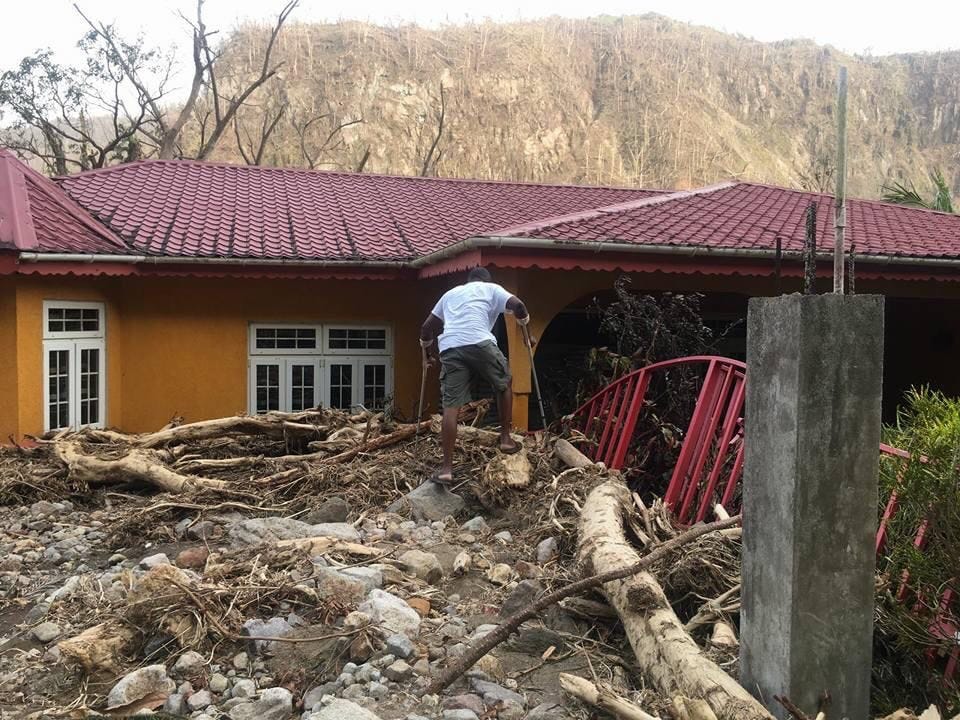
Picture of my dad in front of our home after Hurricane Maria.
On the international stage, we talked about the 226% loss in Gross Domestic Product (GDP). We talked about how we felt.
However, we could not adequately account for the loss of biodiversity and forest cover, and how that affected the people, land, and water.
I think quantifying these aspects was a critical component that was missing.
That gap stayed with me. I knew it mattered. I just didn’t yet know what I could do about it.
That spring semester, I got my first real taste of research.
I learned how to knock out genes using Polymerase Chain Reaction (PCR). I also looked at how the fungus, which causes rice blast disease, Magnaporthe oryzae, affects different varieties of rice.
Being in the lab, working through questions, and discovering things felt great.
Looking back, my introduction to research came at a critical time, when I was trying to figure out what life after my bachelor’s degree would look like. And quietly, something in me was beginning to wake up.
During that spring semester, I enrolled in a landscape ecology class simply because it sounded interesting. I had no idea what it really was. I just thought, “General ecology wasn’t too bad.”
Ecology can be broken down into eco, meaning nature or environment and logy - the study of or the science of. So in short, we look at how the arrangement of the environment (landscape), influences processes, organisms, and where they can live (species distribution).
Fun Fact: A waterscape could also be a landscape.
The professor, Dr. Kusum Naithani, was also quite invested in her teaching and the students who attended her class. She met with all her students one-on-one. I can’t speak for them, but in our first meeting, you could feel her warmth.
Funny story, I was afraid of her when we first met. It was her first year teaching at the University of Arkansas and my first year attending. She taught the second half of the General Ecology course that I took. I thought she was was strict…and I did not like doing homework then. Hahaha. So the math was not mathing.
Dr. Naithani reminded me of a more mature version of myself. We connected on multiple levels, and over time, she asked me a question that would stay with me:
Have you considered graduate school? Or research?
She saw something in me that I hadn’t yet recognized.
I just thought the R assignments were easy and the readings were interesting. I didn’t realize I had stepped into my zone.
Still, I had medical school on my mind.
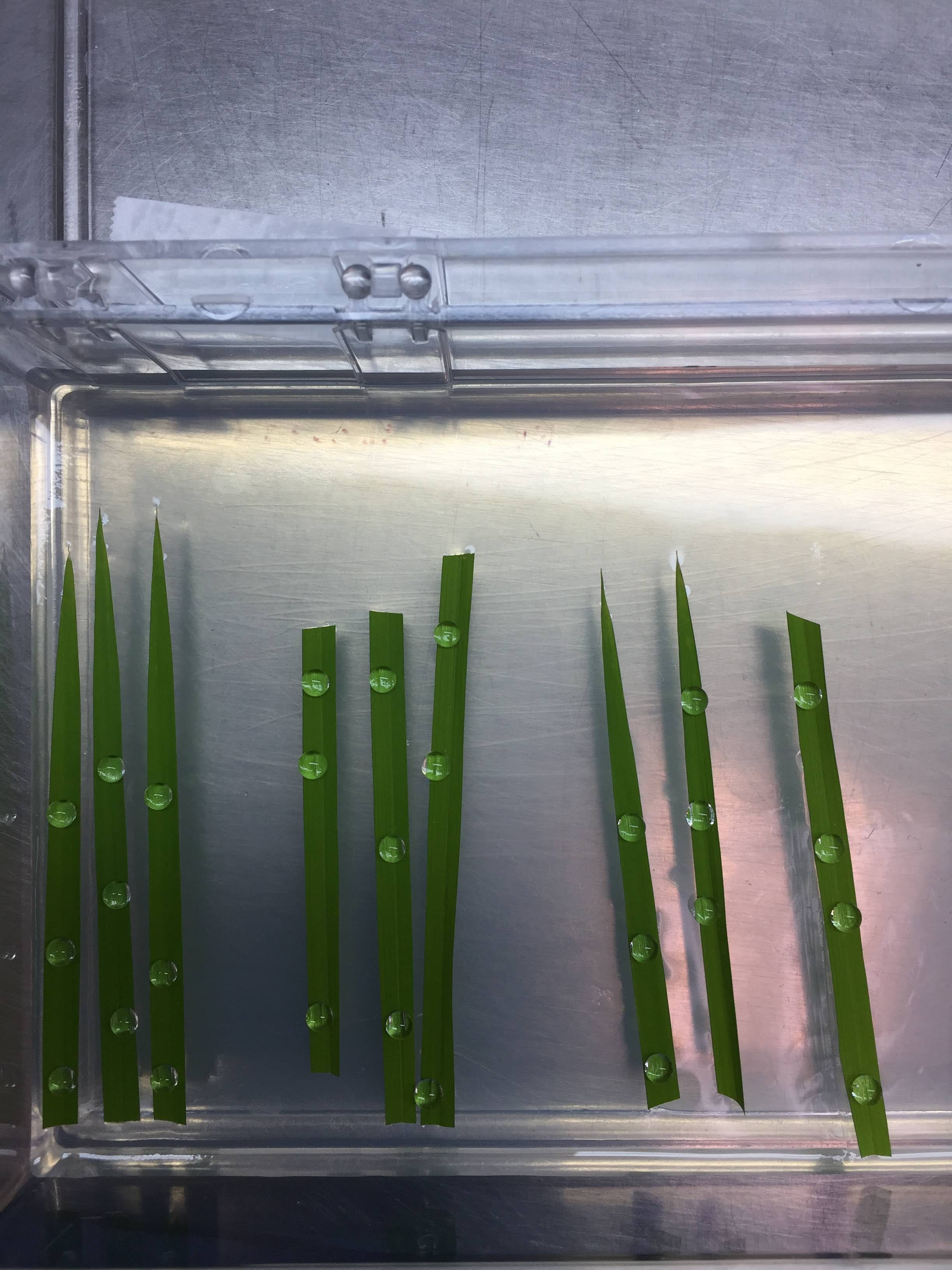
Picture of rice blades inoculated with varying concentrations of growth-inhibited M. oryzae.
That summer, I received a scholarship to work in the plant pathology department. I conducted research on inhibiting the fungus that causes rice blast disease and presented my findings at the end of the program.
I invited Dr. Naithani to my presentation. She didn’t have to come, but she did.
After my presentation, she asked me a simple question:
“What was your favorite part about doing this work?”
That question stayed with me.
Because the truth is, you should love what you do. Or at the very least, recognize that it’s a privilege to do something that genuinely excites you.
I took some time to work and reflect. I asked myself what excited me, where I saw myself, and what kind of impact I wanted to have on the world.
I kept coming back to that question about graduate school. I kept coming back to the possibility of working with Dr. Naithani, not just because she was kind (which she is), but because she’s brilliant! She doesn’t shy away from the hard stuff. Plus, the work itself felt meaningful and full of possibility.
As for graduate school… that came with its own set of challenges, pivots, and lessons.
Stories for another time.
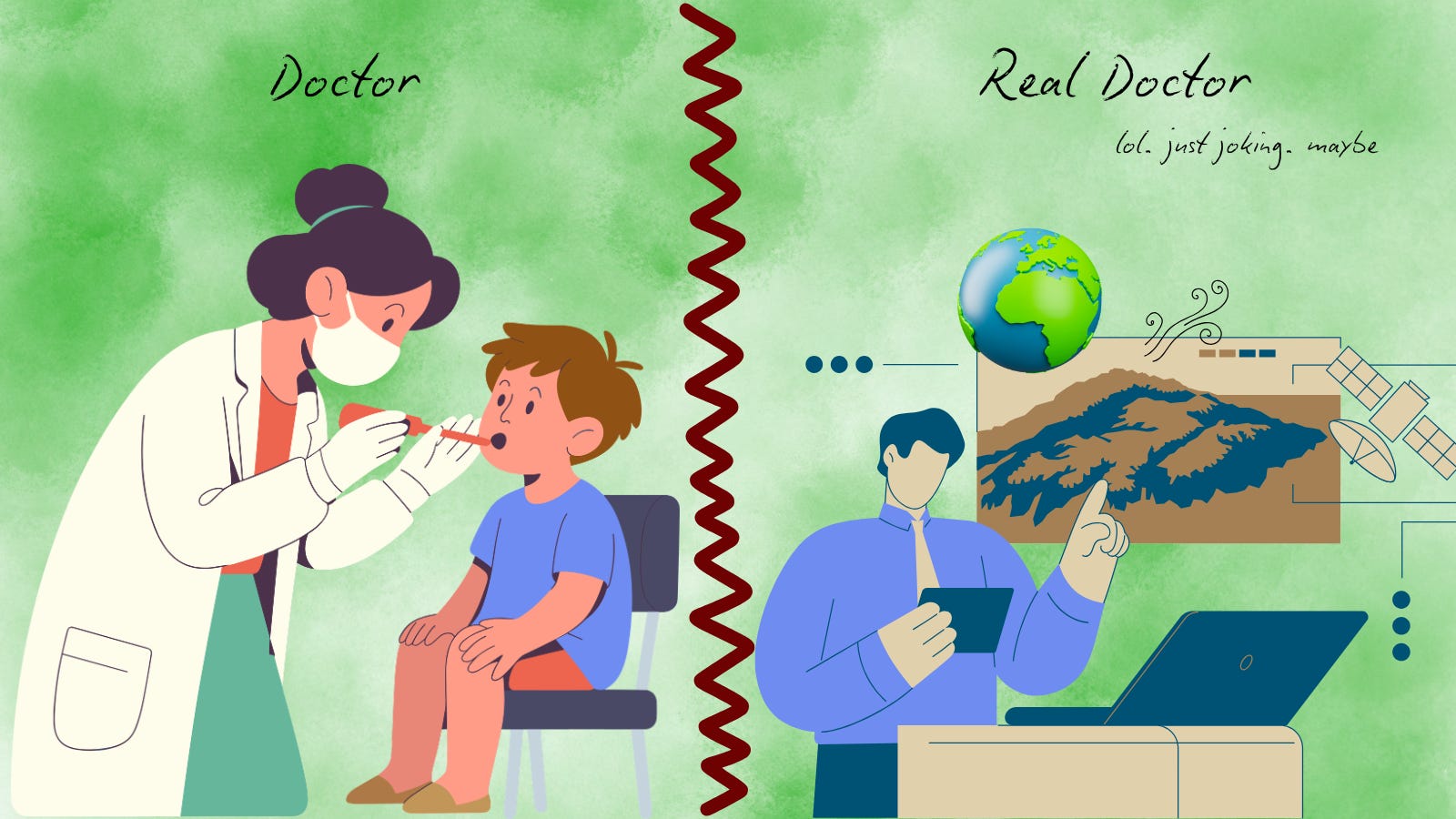
So my answer was:
I can say that I’m genuinely happy I chose the environmental space, even though the journey hasn’t been easy. Most things worth doing rarely are.
I often describe myself as a “jack of all trades.” I’m curious by nature, always exploring, whether that’s through food, travel, data analysis, mapping, modeling, or something entirely new.
Somewhere along the way, I found my way back to my “why.”
I leaned into open data, sustainability, conservation, connecting people, and ecology. I taught myself how to process remote sensing data, among other things.
As you read this, I am on my umpteenth iteration of a scientific paper that is rooted in disturbance ecology, the very thing that first sparked something within me years ago.
In many ways, it feels like everything has come full circle, and yet it feels like my career has just begun.
Sometimes, the things that stir you most deeply - what frustrates you, moves you, or won’t let you go - are pointing you toward what truly sets your heart on fire. Pay attention. This “conviction” might be leading you straight to your purpose.
Let’s Interact!
I want to hear about your journey. Drop a comment below and let’s chat:
What are three words you’d use to describe your career journey?
Mine are: Messy. Pivot. Purpose.
[Leave a comment]